



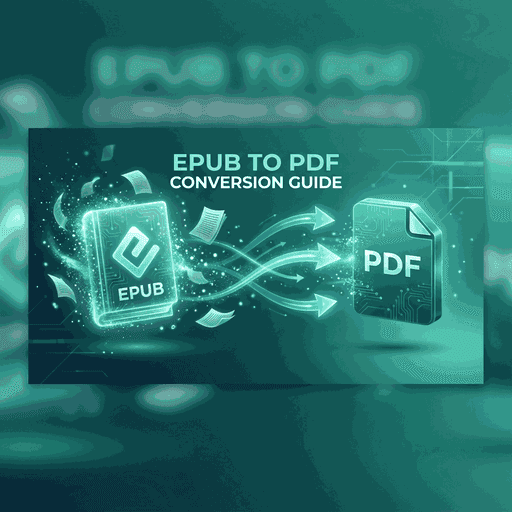
Professional EPUB to PDF conversion workflow visualization
EPUB to PDF Conversion: Complete Guide for 2024
Converting EPUB files to PDF format is one of the most common document transformation tasks in the digital publishing world. Whether you're a student archiving textbooks, an author preparing manuscripts for print, or a reader wanting universal device compatibility, understanding the EPUB to PDF conversion process is essential.
This comprehensive guide covers everything you need to know about converting Electronic Publication (EPUB) files to Portable Document Format (PDF), including technical specifications, conversion methodologies, quality optimization, and common pitfalls to avoid.
Understanding EPUB Format
EPUB (Electronic Publication) is an open-standard ebook format developed by the International Digital Publishing Forum (IDPF). It's essentially a ZIP archive containing HTML, CSS, and XML files that define the book's structure and content.
Key Characteristics of EPUB
- Reflowable Content: Text adapts to screen size, font preferences, and reading device specifications
- Open Standard: Based on web technologies (HTML5, CSS3, JavaScript)
- Rich Metadata: Supports extensive book information including author, publisher, ISBN, and copyright
- Interactive Elements: Can include audio, video, and JavaScript-based interactions
Why Convert EPUB to PDF?
While EPUB excels at digital reading, PDF offers distinct advantages in specific scenarios:
Print-Ready Documents
PDFs maintain fixed layouts perfect for printing. Academic papers, research documents, and professional reports require consistent pagination—something EPUB cannot guarantee due to its reflowable nature.
Universal Compatibility
Every modern device can open PDFs without additional software. Shareability across platforms—Windows, Mac, Linux, iOS, Android—is unmatched.
Archival Purposes
Long-term document preservation demands format stability. PDFs, standardized as ISO 32000, ensure your content remains accessible decades from now.
Citation Requirements
Academic citations require fixed page numbers. PDF's static pagination enables proper references—impossible with EPUB's dynamic layout.
How EPUB to PDF Conversion Works
Converting EPUB to PDF involves multiple technical steps. Understanding this process helps you achieve optimal results:
Step 1: Archive Extraction
The converter unzips the EPUB file, revealing its container structure:
- •
META-INF/container.xml- Points to the content OPF file - •
content.opf- Manifest listing all resources - •
toc.ncx- Table of contents navigation - •XHTML/HTML chapter files, CSS stylesheets, images, fonts
Step 2: Content Parsing
The OPF file's "spine" element defines reading order. Each chapter (XHTML file) is loaded with its associated CSS. Fonts, images, and multimedia assets are resolved from relative paths to absolute references.
Step 3: Rendering Engine
A headless browser (typically Chromium-based) renders each chapter:
- •Applies CSS stylesheets including print media queries
- •Calculates page breaks using
break-inside,break-afterproperties - •Embeds custom fonts as PDF subsets
- •Converts images to appropriate compression (JPEG for photos, PNG for graphics)
Step 4: PDF Generation
The rendered pages are assembled into a PDF document. Hyperlinks are converted to PDF annotations, and the NCX navigation becomes PDF bookmarks, enabling chapter-to-chapter jumping in readers.
Optimizing Conversion Quality
Common Quality Issues
Many free converters produce poor results. Watch for broken layouts, missing images, incorrect fonts, and orphaned text. Professional tools invest in proper rendering engines.
Page Size Selection
Choose PDF dimensions matching your use case: A4 (210×297mm) for documents, Letter (8.5×11in) for US printing, or custom sizes for tablets.
Font Handling
Ensure all fonts are embedded. Missing fonts cause text to render incorrectly. Our converter includes fallback font substitution for maximum compatibility.
Image Optimization
Balance file size vs. quality. High-resolution images are downsampled to 300 DPI for print, 150 DPI for screen reading—maintaining clarity while controlling PDF size.
Real-World Applications
📚 Academic Research
Students convert textbooks for annotation. Researchers archive papers with consistent citations. Libraries preserve digital collections.
✍️ Publishing Workflow
Authors prepare manuscripts for print-on-demand. Editors review layouts. Publishers create PDF proofs before final production.
💼 Corporate Training
Companies distribute training materials. Employees access manuals offline. Compliance departments archive documentation.
Why Are PDF Files Larger Than EPUB?
A 2MB EPUB often becomes an 8-12MB PDF. Here's why:
- 1.Font Embedding: PDFs include complete font subsets. An EPUB might reference system fonts; PDFs embed every glyph.
- 2.Image Decompression: EPUB stores compressed PNGs. PDFs may store uncompressed rasters for rendering speed.
- 3.Page Objects: Each PDF page is a complete object with drawing instructions. EPUBs share CSS across chapters.
Tip: Use our "Compress PDF" tool post-conversion to reduce file size by 50-70% without visible quality loss.
Frequently Asked Questions
Can I convert DRM-protected EPUB files?
No. Digital Rights Management (DRM) encryption prevents unauthorized conversion. You must remove DRM first using legal methods (e.g., purchasing DRM-free versions or using Calibre with de-DRM plugins for books you legally own). Adobe Digital Editions (.acsm) files cannot be directly converted.
Will hyperlinks work in the converted PDF?
Yes. Internal links (to other chapters) and external URLs are converted to PDF link annotations. Clicking them works identically in PDF readers. The table of contents becomes interactive PDF bookmarks.
Can I convert Kindle (AZW/AZW3) files?
Kindle formats are proprietary. First convert AZW/AZW3 to EPUB using Calibre (free, open-source software). Then use our tool for EPUB to PDF conversion. This two-step process preserves formatting better than direct Kindle-to-PDF conversion.
What happens to the table of contents?
The EPUB's NCX (Navigation Control file for XML) or NAV (HTML5 navigation) becomes PDF bookmarks. Open the sidebar in Adobe Acrobat, Preview, or any PDF reader to see the chapter outline and jump between sections.
Is the conversion process secure?
Absolutely. Files are processed in isolated server instances with volatile storage. Once conversion completes and you download the PDF, all source files and outputs are permanently deleted. We never store, scan, or access your content.
Can I batch convert multiple EPUB files?
Yes. Upload multiple EPUBs simultaneously. You'll receive three download options: (1) Merged PDF containing all books sequentially, (2) ZIP archive with individual PDFs, (3) Individual download buttons for each converted file.
How long does conversion take?
Processing time depends on file size and complexity. A 200-page novel converts in 15-30 seconds. Heavily illustrated textbooks may take 1-2 minutes. Large batches process in parallel for maximum speed.
Start Converting EPUB to PDF Today
Our professional-grade converter handles complex EPUBs with embedded fonts, high-resolution images, and multi-level navigation. Whether you're converting a single file or processing an entire library, we deliver publication-quality PDFs in seconds.
100% Free. No registration required. Unlimited conversions. Try it now with your EPUB files.