



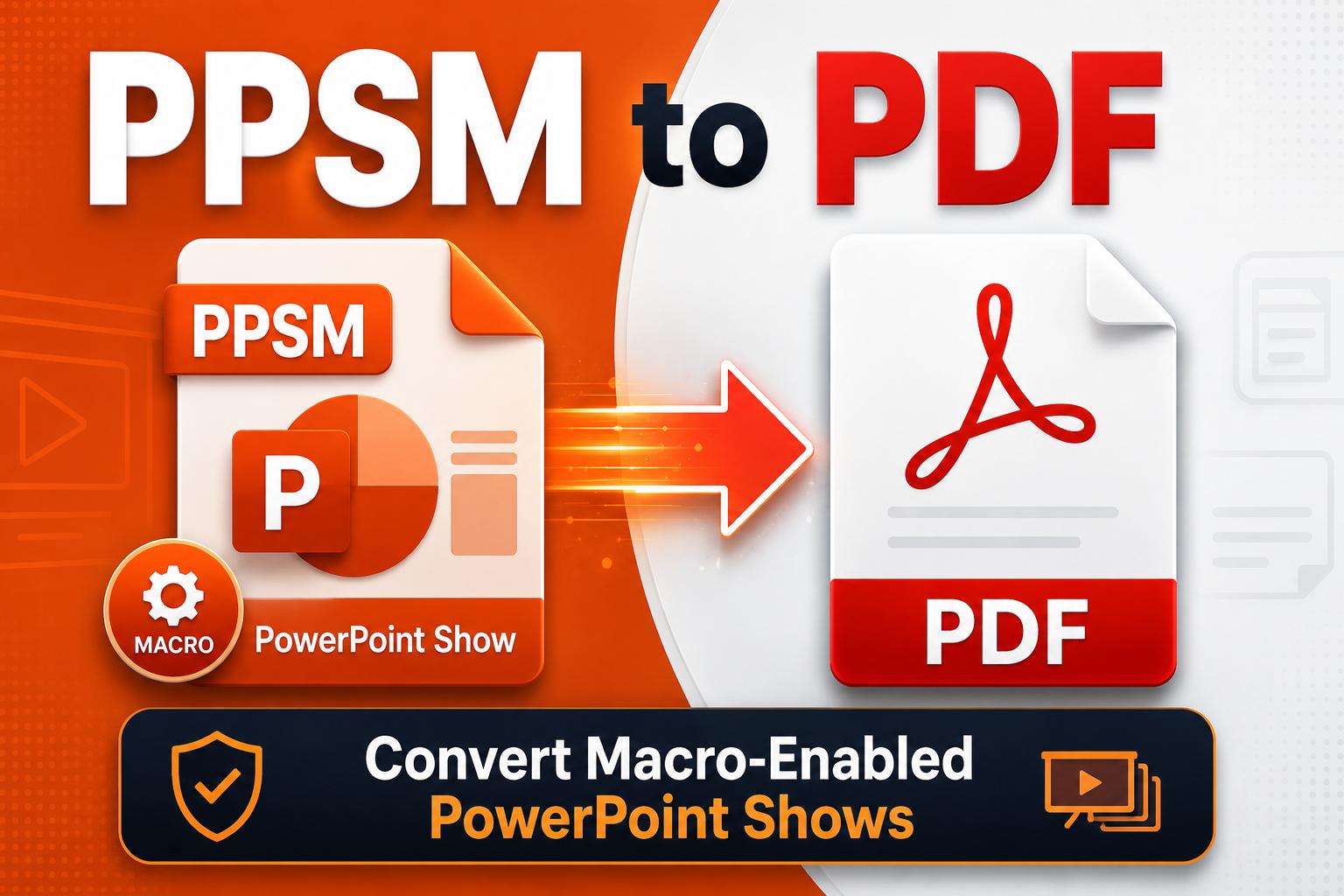
Secure & Static: PPTM to PDF
The definitive guide to sanitizing Macro-Enabled PowerPoint presentations (.pptm) by converting them into harmless, universal PDF documents.

Guide Overview
What is a PPTM File?
The .pptm extension stands for "PowerPoint Open XML Macro-Enabled Presentation." It is functionally identical to the standard .pptx format, with one critical difference: it is explicitly authorized to contain VBA (Visual Basic for Applications) macros.
Microsoft separates .pptx (safe) and .pptm (potentially unsafe) files to prevent users from accidentally executing code. If you try to save macros in a .pptx file, PowerPoint will strip them out. The .pptm format is the designated container for presentations that need automation, such as:
Automation
Scripts that automatically update charts from Excel, fetch live data, or generate slides.
Interactivity
Custom forms, quizzes, or complex navigation buttons that use VBA logic.
Malware Potential
Unfortunately, this same capability is often used by attackers to hide viruses.
Why Are Macros Dangerous?
VBA is a complete programming language. A macro can delete files, install software, or send emails from your computer without your explicit permission once enabled.
The "Mark of the Web"
Modern Windows systems apply a "Mark of the Web" to files downloaded from the internet, automatically blocking macros in .pptm files. This makes sharing .pptm files incredibly difficult, as the recipient usually sees a security warning or cannot run the file at all.
The Solution: Neutralize via PDF
Converting a .pptm file to PDF is the most effective way to share the visual content of your presentation without sharing the risk.
Total Sanitization
The PDF format does not support VBA. When you convert, the "brain" (code) is stripped away, leaving only the "body" (slides). This file is now 100% safe to open on any government, corporate, or school network.
Bypass Email Filters
If you try to email a .pptm file to a client, their firewall will likely reject it. A PDF, however, is a trusted document standard that passes through all security filters.
Visual Preservation
Even though the code is gone, the result of that code (if it generated visual elements before saving) is preserved. You get a perfect visual replica of the slides.
Archival Ready
Code rots. VBA scripts written 10 years ago might not run on Windows 11. PDF is ISO-standardized (PDF/A) to remain readable for decades, making it the only choice for long-term storage.
What You Lose & Keep
| Element | Result in PDF | Notes |
|---|---|---|
| Slide Designs | Preserved | High fidelity vector text and images. |
| VBA Code | Removed | The `vbaProject.bin` part is discarded. |
| Action Buttons | Static | Buttons appear as images but are not clickable. |
| Animations | Flattened | Only the final state of the slide is shown. |
| Hyperlinks | Preserved | Standard external URL links usually work. |
How to Convert Safely
Upload PPTM
Drag your file into our secure area. Our server accepts the file but does not execute any auto-run macros on load.
Extraction
We parse the `slides/` directory within the Open XML package, completely bypassing the `vbaProject.bin` file where malicious code would reside.
Download PDF
Your new file is a pure PDF. It contains no scripts, no macros, and no security warnings. It is safe to send to anyone.
Frequently Asked Questions
Does this delete the macros from my original file?
No. The conversion process creates a new PDF file. Your original .pptm file on your computer remains untouched and fully functional.
Can I view the code in the PDF?
No. If you need to share the VBA code itself, you should copy the code into a text file or use a "Print Code to PDF" feature within the VBA Editor. This tool only converts the slides.
Why are my conditional form buttons gone?
Buttons in PPTM often rely on macros logic (e.g., "If score > 50, show Slide 5"). Since PDF is flat and linear, this logic cannot exist. The buttons will appear as static images.
Secure Your Presentations
Convert your .pptm files to standard PDFs for risk-free sharing, compliant archiving, and universal accessibility.