



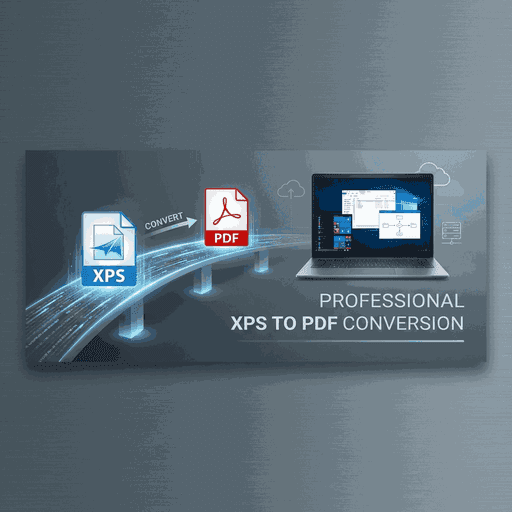
XPS (XML Paper Specification) to PDF conversion process
XPS to PDF Conversion: Complete Microsoft Format Guide
XPS (XML Paper Specification) is Microsoft's alternative to PDF, designed to provide device-independent document representation with high fidelity. Introduced with Windows Vista in 2006, XPS aimed to compete with Adobe's PDF dominance but never achieved widespread adoption outside Windows ecosystems.
Converting XPS to PDF ensures universal compatibility. While XPS viewers exist on Windows, Mac, Linux, and mobile platforms struggle with the format. This comprehensive guide explains XPS structure, conversion methodologies, and best practices for creating perfect PDFs from Microsoft's paper format.
Understanding XPS Format
XPS is fundamentally similar to PDF conceptually—both are fixed-layout formats preserving exact visual appearance across devices. However, XPS uses XML and ZIP packaging (similar to Office Open XML) rather than PDF's PostScript heritage.
XPS Technical Specifications
- ZIP Container: XPS files are renamed ZIP archives containing XML markup and resources
- FixedDocument Structure: Pages defined in XML with precise positioning coordinates
- Vector Graphics: Shapes, paths, and text stored as scalable vectors (not rasterized)
- Font Embedding: TrueType/OpenType fonts subset and included for typographic accuracy
XPS vs PDF: The Format War
Microsoft positioned XPS as an open alternative to PDF (ironic, given PDF is ISO 32000). XPS is technically standardized as ECMA-388, but ecosystem adoption never materialized. Windows 10+ relegated XPS to legacy status, making PDF conversion essential.
Why Convert XPS to PDF?
🌐 Cross-Platform Access
XPS viewers are scarce on Mac, Linux, iOS, and Android. PDF readers are ubiquitous. Convert for instant compatibility everywhere.
📧 Email Attachments
Many email clients and recipients cannot open XPS. PDFs display inline in Gmail, Outlook, and webmail—no download required.
🏢 Enterprise Workflows
Legacy Windows systems generated XPS from print dialogs. Modern document management systems expect PDF. Convert for workflow integration.
📚 Long-Term Archiving
PDF/A (ISO 19005) is the archival standard. XPS's uncertain future makes PDF conversion critical for ensuring decades of accessibility.
XPS to PDF Conversion Process
Step 1: Package Extraction
XPS files are unzipped to reveal internal structure:
- •
FixedDocumentSequence.fdseq- Document root - •
Documents/- Contains FixedDocument parts - •
Pages/- Individual page markup (XAML-like XML) - •
Resources/- Fonts, images embedded resources
Step 2: XML Parsing
Page content is parsed from XML. Vector paths (curves, shapes) are extracted with precise coordinates. Text is rendered using embedded fonts. Images are decoded from their binary streams.
Step 3: Graphics Conversion
XPS vector graphics are translated to PDF drawing primitives. Bezier curves, gradients, and transparency effects map directly to PDF equivalents. No rasterization—vectors remain scalable.
Step 4: PDF Assembly
Pages compile into a single PDF. Hyperlinks (NavigateUri) become PDF link annotations. Document properties (title, author) transfer to PDF metadata. Font subsets are re-embedded if needed.
OXPS vs XPS: What's the Difference?
Open XPS (OXPS) is the ECMA-standardized version introduced in Windows 8. Minor differences exist in packaging and metadata, but both represent the same fixed-document format.
Compatibility Notes
Our converter handles both .xps and .oxps files identically. Windows 10+ defaults to OXPS when printing to XPS Document Writer. Both convert to PDF with identical quality.
Real-World Applications
🖨️ Print-to-File Archives
Users who selected "Microsoft XPS Document Writer" as printer created XPS files instead of PDFs. Convert these archives for modern compatibility.
💼 Corporate Documentation
Enterprises with legacy XPS workflows (invoices, reports, contracts) convert to PDF for integration with modern document management systems.
📊 Technical Drawings
CAD and engineering software sometimes exports to XPS. Converting to PDF enables sharing with clients and contractors using standard viewers.
Commonly Asked Questions
Insights into XPS and its conversion to PDF
Will hyperlinks work in the PDF?
Yes! XPS NavigateUri elements (internal chapter links and external URLs) convert to PDF link annotations seamlessly. Your clickable links will remain active.
Are vector graphics preserved?
Absolutely. XPS paths, curves, and shapes convert directly to PDF vector primitives. This means no pixelation—graphics remain infinitely scalable.
Can I convert OXPS files?
Yes. OXPS (Open XPS) is fully supported. Simply upload your .oxps files exactly as you would with .xps files. The quality is identical.
Will fonts display correctly?
Yes. XPS embeds font subsets, which we extract and re-embed into the resulting PDF. This ensures the text looks the same on any device.
Can I batch convert multiple XPS files?
Yes! You can upload multiple files at once. We'll handle them in parallel and let you download them all in a single ZIP or merged together.
Convert XPS to PDF Today
Free your documents from Microsoft's legacy format. Universal PDF compatibility, perfect vector preservation, and instant cross-platform access. Unlimited free conversions.
No software installation. Works in your browser. Start now.